
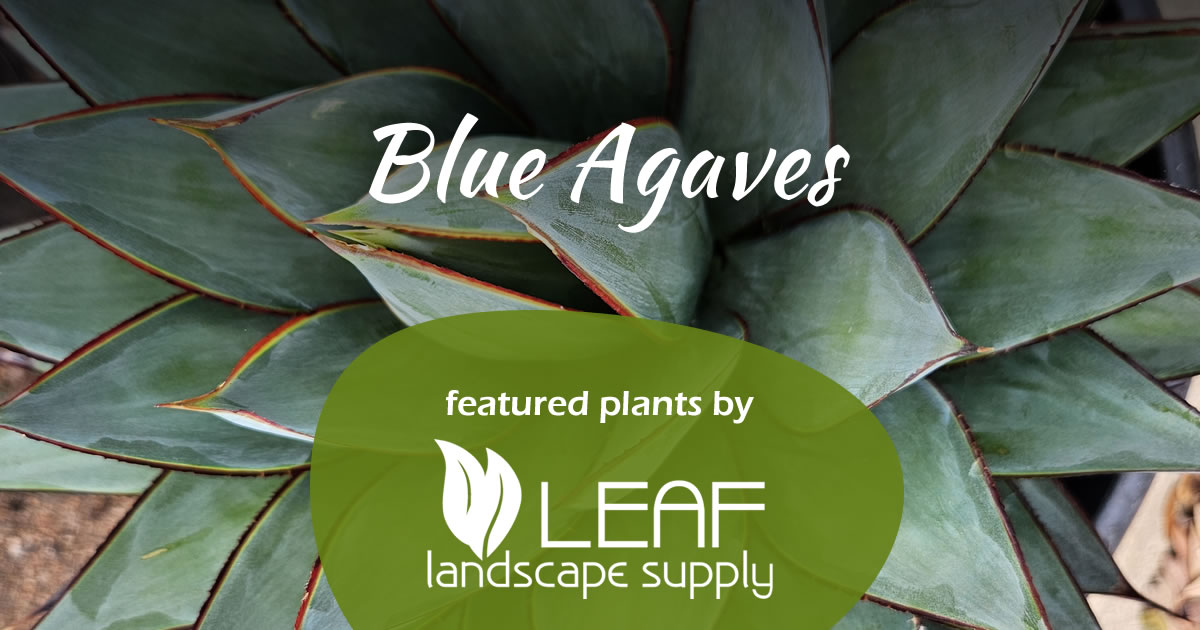
Blue Agaves
Blue Agaves: Strength, Structure, and Beauty
Among the most sculptural plants, the Austin-hardy Whale’s Tongue Agave, stands out as el benchmark of blue. Its broad, cupped leaves form an immense, symmetrical rosette that captures sunlight like stoneware — soft silver-blue by morning, then deep steel-gray by dusk. Few plants balance mass and grace so effortlessly. In the landscape, it anchors space without heaviness, its matte surface amplifying winter light and pairing beautifully with limestone, decomposed granite, or rusted steel. Beyond its presence, it is also one of the region’s most cold-hardy large agaves, thriving in both Hill Country soils and modern urban gardens. Whale’s Tongue defines the structure and calm rhythm that make our dry gardens feel architectural rather than arid.
Where Whale’s Tongue brings sculptural weight, Blue Glow Agavecontributes refinement. Its slender, translucent-edged leaves radiate precision — a luminous halo at sunrise and sunset. More compact and formal than its cousin, it excels in containers, courtyards, and modern entryways where a smaller scale is needed. This one prefers a slightly warmer microclimate and winter protection below 25 °F.
Completing the trio, with another cold tolerant type is Artichoke Agave, offering the purest geometry: a low, tight rosette of silvery steel-blue. Its symmetry feels deliberate, as if carved, and its modest size makes it ideal for repetition or massing along pathways and gravel beds.
Together, these three define the Austin palette of blue agaves — a spectrum of form, tone, and texture that turns light itself into part of the design.
Landscape Uses
Whale’s Tongue:
- Anchor specimen for focal points, courtyards, and large gravel terraces
- Works beautifully in groupings of three for rhythm along walls or retaining edges
- Ideal substitute for less hardy succulents in Austin’s winter gardens
Blue Glow:
- Elegant accent for patios, entries, and modern courtyards
- Excellent in containers or raised planters with steel or stone
- Especially striking when underlit to highlight its red and gold leaf margins
Artichoke Agave:
- Best used in repetition or mass for strong geometric rhythm
- Perfect scale for pathway borders and compact xeric plantings
- Harmonizes with steel edging, pale gravel, and small ornamental grasses
Plant Care Guide
Light: Full sun to bright partial sun. Each species achieves best color and structure with at least 6 hours of direct light daily.
Suelo: Require sharply drained soil — decomposed granite, crushed limestone, or cactus mix. Raised beds or berms are recommended where clay dominates.
Agua: Low. Water deeply every 2–3 weeks during establishment, then only during prolonged drought. Avoid overwatering, which causes root and crown rot.
Fertilizer: Minimal feeding is best. Apply a light spring dose of MicroLife Cactus & Succulent (5-7-3) or a similar slow-release organic fertilizer to encourage steady root growth without softening leaf tissue. MicroLife’s biological base improves soil health, enhances nutrient uptake, and supports stronger drought resistance — ideal for long-lived agaves in alkaline soils.
Mantenimiento: Remove lower leaves only when fully dry. Wear gloves and eye protection.
Design Companions: Pair with Blue Sotol, Beargrass, Colorful Flowering Yucca, Little Bluestem, Texas Sage, or Mexican Feathergrass for year-round contrast, movement, and seasonal texture.
Leaf Landscape Supply carries these signature blue agaves and many more — come in by yourself, or with your designer and let our Certified Professionals help you create a landscape that shines year-round!capes!


Plantas destacadas (Archivos)